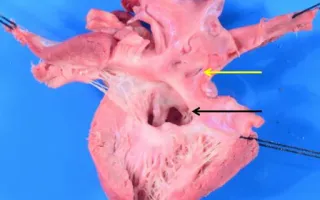
2nd trimester live-born female who passed away from complications of prematurity. Incidental cardiac findings.
Case Discussion
Atrioventricular septa defect (AVSD) is a congenital heart defect consisting of an abnormal opening connecting the left and right heart chambers.
This slide shows the main defect (black arrow) from the left sided chambers. There is also a second smaller defect present in the atrial septum, which could be considered either as a large patent foramen ovale or alternatively as a small secundum type atrial septal defect. A close up and image from the right sided chambers can be found in Related Content.
AVSDs are considered endocardial cushion defects, which refers to the location where the atrial and ventricular septa meet. There are several subtypes of AVSD. Partial AVSDs have a defect in the inferior part of the atrial septum but no true intraventricular communication. Complete AVSDs have a ventricular connection. The AV valves (tricuspid and mitral) essentially become a single valve. The defects can also be balanced, where the ventricles maintain similar size proportions, or unbalanced, where the ventricles show significant differences in size. A significant portion of complete AVSDs are associated with Down syndrome. Due to the valvular abnormalities, surgical repair requires both closure of the defect and repair of the valves to reduce regurgitation.
Wang, T., Chiasson, D. Heart, Atrioventricular septal defect. Digital Laboratory Medicine Library, Dept of Laboratory Medicine & Pathobiology, University of Toronto. Published
. Accessed December 17, 2025. https://dev.dlml.cflabs.ca/image/heart-atrioventricular-septal-defect-lmp42081