Classical Hodgkin lymphoma, nodular sclerosis type
Clinical History
Left cervical lymphadenopathy.
Case Discussion
Nodular sclerosis classical Hodgkin lymphoma, (NSCHL) is the most common subtype of classical Hodgkin lymphoma. Its incidence is similar in males and females and peaks at ages 15-34 years. NSCHL has a better prognosis overall than other types of CHL. However, massive mediastinal disease is an adverse prognostic factor.
Histologically, the lymph nodes are characterized by collagen bands that surround at least one nodule, and scattered Hodgkin and Reed-Sternberg (HRS) cells with lacunar morphology. Eosinophils, histiocytes and to a lesser extent neutrophils are often numerous.
Immunohistochemically, HRS cells are positive for CD30 in nearly all cases and for CD15 in the majority of cases. Both CD30 and CD15 are typically present in a membrane pattern with accentuation in the Golgi area. HRS are negative for CD45, and CD20 may be detectable in 30-40% of the cases.
The immunostaining of HRS cells for PAX8 (B-cell activator protein) is usually weaker than that of reactive B cells, a feature that makes PAX5-positive HRS cells easily identifiable. The plasma cell specific transcription factor IRF4/MUM1 is consistently positive in HRS, usually at high intensity.
Positivity for Epstein-Barr virus (EBV) is only seen in 10-40% of the cases.
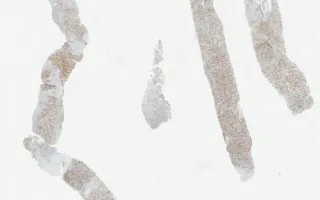
This slide shows MUM1 stain. See Related Content for H&E, CD30, CD15, and PAX5.
Starova, B., Ghorab, Z. Lymph node, Hodgkin lymphoma, MUM1 stain. Digital Laboratory Medicine Library, Dept of Laboratory Medicine & Pathobiology, University of Toronto. Published
. Accessed December 17, 2025. https://dev.dlml.cflabs.ca/image/lymph-node-hodgkin-lymphoma-mum1-stain-lmp27373