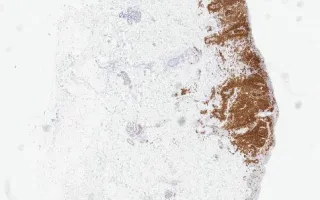
Four-month old female infant with a 2-month history of generalized scaly papular rash. Otherwise well. Punch biopsy of a characteristic lesion from the back.
Case Discussion
Langerhans cell histiocytosis (LCH) refers to an abnormal proliferation of cells arising from or resembling epidermal dendritic cells. Langerhans cells are positive for S100, CD1a, and langerin by immunohistochemistry and contain characteristic Birbeck granules by electron microscopy.
In children LCH is usually considered a clonal (neoplastic) disorder and can involve any organ system. It may be unifocal (e.g. a single osseous lesion, most commonly in the skull), involve a single system (e.g. cutaneous rash), or be multisystemic. Unifocal and single system disease generally have an excellent prognosis. Multisystemic LCH, especially with involvement of marrow, liver, spleen, and/or lungs, can be lethal and is commonly treated with cytotoxic chemotherapy. The presence of a BRAF V600E mutation has been associated with a poorer prognosis.
1. Windebank K & Nanduri V. Langerhans cell histiocytosis. Arch Dis Child. 2009 Nov;94(11):904-8.
2. Mehes G et al. Activating BRAF V600E mutation in aggressive pediatric Langerhans cell histiocytosis: demonstration by allele-specific PCR/direct sequencing and immunohistochemistry. Am J Surg Pathol. 2014 Dec;38(12):1644-8.
Schollenberg, E. Skin, Langerhans cell histiocytosis (LCH) (CD1a). Digital Laboratory Medicine Library, Dept of Laboratory Medicine & Pathobiology, University of Toronto. Published
. Accessed December 17, 2025. https://dev.dlml.cflabs.ca/image/skin-langerhans-cell-histiocytosis-lch-cd1a-lmp87049