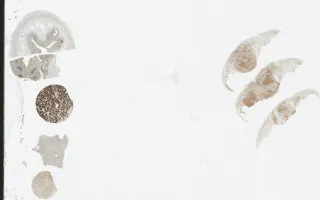
79 year old male with a slowly enlarging right cheek plaque, clinically suspected to be a BCC.
Case Discussion
Primary cutaneous B cell lymphomas (BCBCL) constitute the minority (20-30%) of cutaneous lymphomas (with T cell subtype composing the majority of cases). They are classified into 3 main types: follicle center, marginal zone, and diffuse large B cell. Primary cutaneous follicle center lymphomas (PCFCL) originate from B-cells in the germinal centers of lymphoid follicles. Prognosis is excellent compared to its nodal counterpart (5 year survival >90%, rarely disseminates systematically), but cutaneous recurrence is common.
Histologically, the lymphoid infiltrate is morphologically consistent with centrocytes and few centroblasts. Architectural patterns have been described as either follicular, diffuse or mixed. PCFCL cells are CD20+. CD10+ and BCL-6+, BCL-2, which is commonly positive in extra-cutaneous follicular B-cell lymphoma is usually negative. CD21 usually highlights prominent follicular dendritic cell networks. Additionally, if molecular testing is performed, there is B-cell clonality present which helps exclude pseudolymphoma from the differential diagnosis.
This slide shows CD10 stain. See related content for H&E, CD20, and CD21 stains.
Bobotsis, R., Sade, S. Skin, Primary cutaneous follicle center lymphoma, CD10 stain. Digital Laboratory Medicine Library, Dept of Laboratory Medicine & Pathobiology, University of Toronto. Published
. Accessed December 17, 2025. https://dev.dlml.cflabs.ca/image/skin-primary-cutaneous-follicle-center-lymphoma-cd10-stain-lmp79083