Details
51-year old man with a testicular mass.
The overwhelming majority of testicular tumours are derived from germ cells. There are different histologic subtypes of germ cell tumours which are generally divided in seminomatous and non-seminomatous tumours. Germ cell tumours may be composed of a single histologic subtype, but it is more common for them to be composed of two or more subtypes.
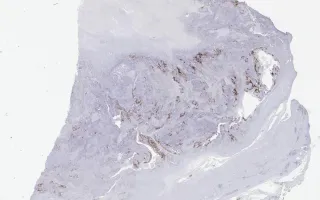
This is a germ cell tumour specimen that is comprised of embryonal carcinoma (roughly 90%), yolk sac (7%) and seminoma (3%). The estimated tumour makeup was based on the combination of histology and immunohistochemistry. Embryonal carcinoma is highlighted by CD30. Yolk sac tumour is highlighted by glypican(-3). Choriocarcinoma can be highlighted using beta-hCG or GATA3, and this component was not found (not shown).
When seminoma is suspected, addition of CD117 may be considered; the combination of CD30 and CD117 is helpful in distinguishing seminoma from embryonal carcinoma (Lau 2007 Mod Pathol). Seminoma was present in another block as a minor component (not shown).
When available, it would be prudent to correlate the serum workup with the pathology. Elevated serum beta-hCG should increase one’s suspicion for choriocarcinoma, although beta-hCG can also be elevated in about 5-10% of seminomas.
This slide shows glypican stain. See Related Content for H&E, CD30, and B-HGC stains.
See Related Content for References:
1) Lau, SK, et al. Mod Pathol. 2007 Mar;20(3):320-5
Other examples of germ cell tumours in the collection include (see Related Content for links):
Testis, Mixed germ cell tumour [LMP54949]
Testis, Seminoma [LMP71477]