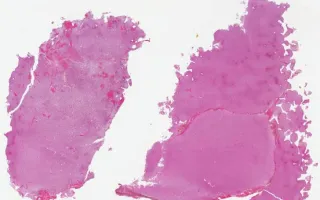
34-year-old man with seizures. Neuroimaging shows a non-enhancing right frontal tumour.
Case Discussion
Diffuse astrocytoma is a diffusely infiltrating glioma that almost always harbours mutations in isocitrate dehydrogenase (IDH1 or IDH2) and are either designated as IDH-mutant or IDH-wildtype. They are classified as WHO grade II. Typically, they occur in younger adults and arise in the cerebral hemispheres. Microscopically, diffuse astrocytoma is composed of fibrillary astrocytes with oval to elongated nuclei in a background of loose or microcystic matrix. The presence of rounder tumour nuclei with extensive mucoid degeneration was previously described as the protoplasmic variant. The presence of tumour cells with plump, glassy, eosinophilic cell bodies in >20% of the tumour is described as the gemistocytic variant. The presence of brisk mitotic activity corresponds to anaplastic astrocytoma (WHO grade III) and either microvascular proliferation or necrosis correspond to glioblastoma (WHO grade IV). IDH1 R132H mutation can be detected by immunohistochemistry. Molecular alterations commonly associated with IDH-mutant astrocytomas include ATRX mutation (loss of protein expression) and p53 mutation. These accompanying mutations are mutually exclusive with 1p/19q-codeletion seen in IDH-mutant oligodendrogliomas. Median survival is approximately 10 years.
This slide shows H&E stain. See Related Content for IDH1 and ATRX stains.
Gao, A., Munoz, D. Brain, Diffuse astrocytoma, H&E stain. Digital Laboratory Medicine Library, Dept of Laboratory Medicine & Pathobiology, University of Toronto. Published
. Accessed December 17, 2025. https://dev.dlml.cflabs.ca/image/brain-diffuse-astrocytoma-he-stain-lmp21350