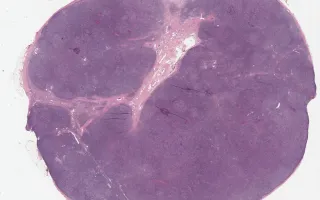
Nodular lymphocyte predominant Hodgkin lymphoma (NLPHL) accounts for approximately 5% of all Hodgkin lymphomas. It most commonly occurs in children and young to middle-aged adults with a marked male predominance (M/F ratio 3 : 1). It typically presents as a solitary enlarged peripheral lymph node, most commonly in the neck, groin, or axilla. Mediastinal, bone marrow and splenic involvement are very rare. Most patients have early stage disease (80% stage I or II), and systemic symptoms are uncommon.
Histologically, it is characterized by a nodular or a nodular and diffuse infiltrate of predominately small lymphocytes, histiocytes and scattered large, mononuclear neoplastic cells with folded/multilobulated nuclei known as popcorn or lymphocyte predominant (LP) cells (formerly known as L&H cells).
Immunohistochemically, the LP cells are positive for CD20, CD7ga, BCL6, and CD45 in nearly all cases. They lack CD15 and CD30 expression; however, reactive CD30+ immunoblasts may be seen. Most of the LP cells are ringed by CD3+ T cells and to a lesser extent by CD57+ T cells. LP cells are consistently negative for Epstein-Barr virus (EBV) virus, but bystander lymphocytes may show EBV positivity.
This slide shows H&E stain. See Related Content for CD20 and CD3 stains.
Starova, B., Ghorab, Z. Lymph Node, Nodular lymphocyte predominant Hodgkin lymphoma, H&E stain. Digital Laboratory Medicine Library, Dept of Laboratory Medicine & Pathobiology, University of Toronto. Published
. Accessed December 17, 2025. https://dev.dlml.cflabs.ca/image/lymph-node-nodular-lymphocyte-predominant-hodgkin-lymphoma-he-stain-lmp72157