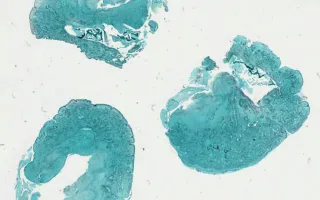
Invasive aspergillosis is an aggressive fungal infection that results in tissue necrosis and destruction of the sinonasal tract. It most commonly presents in patients whose immune system has been compromised. Early diagnosis and treatment includes debridement and IV antifungals. These are critical in decreasing the risk of morbidity and mortality.
Although fungi can be seen on routine tissue sections, speciation of fungi requires fungal culture. Aspergillus fungi have thin, septate hyphae (2-5 µm), with acute angle branching (45°) or dichotomous branching. In contrast, Mucor fungi have larger, non-septate hyphae (7-20 µm), with wider angle branching up to 45-90°.
Histochemical staining such as GMS and PAS are used to detect fungi. In-situ hybridization is also used in cases with negative cultures.
This slide shows GMS stain. See Related Content for H&E stain.
Basheer, M., MacMillan, C. Nasal Sinus, Invasive aspergillosis, GMS stain. Digital Laboratory Medicine Library, Dept of Laboratory Medicine & Pathobiology, University of Toronto. Published
. Accessed December 17, 2025. https://dev.dlml.cflabs.ca/image/nasal-sinus-invasive-aspergillosis-gms-stain-lmp72561