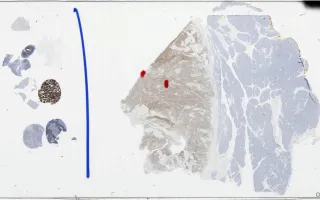
15-year old female patient with a pancreatic mass in the tail.
Case Discussion
Solid pseudopapillary tumour (SPPT, SPP neoplasm) is a pancreatic neoplasm generally seen in women of child-bearing age. This patient, relatively young for the neoplasm, presented with vague abdominal pain, which is a common clinical scenario. Grossly, the tumour was confined to the tail of the pancreas.
As the name suggests, the tumour is a well delineated mass comprised of solid and pseudopapillary areas. It is a cellular lesion, and the epithelial cells that form those areas somewhat mimic endocrine tumours. One can appreciate the hyaline globules, which can be seen on both the H&E and PAS slides. The neoplasm exhibits variable expression of epithelial, mesenchymal, and endocrine markers, and, accordingly, the tumour can show ultrastructural features of acinar, ductal and endocrine cell differentiation. Progesterone receptor, CD10 and alpha-1-antitrypsin expression is seen, along with nuclear beta-catenin expression. CTNNB1 gene (which encodes the beta-catenin protein) mutations are commonly detected.
Ultrastructurally, endoplasmic reticulum-like structures can be seen. These structures actually represent annulate lamellae, which are more analogous to the nuclear envelope and contain nuclear pore complexes. Electron-dense cytoplasmic granules and pleomorphic mitochondria are also seen. While all these features can be seen frequently in SPPT, they are not unique features.
This slide shows CD10 stain. See related content for H&E, B catenin, and PAS stains.
Yoon, J. Pancreas, Solid pseudopapillary tumour, CD10 stain. Digital Laboratory Medicine Library, Dept of Laboratory Medicine & Pathobiology, University of Toronto. Published
. Accessed December 17, 2025. https://dev.dlml.cflabs.ca/image/pancreas-solid-pseudopapillary-tumour-cd10-stain-lmp25987