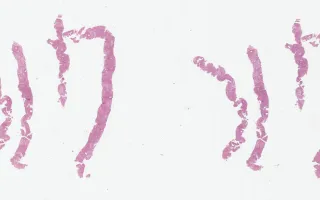
History of follicular lymphoma and bone marrow transplant.
Case Discussion
The histological pattern seen in hepatic Graft-versus-host disease (GVHD) can be strikingly similar to that found in transplant rejection cases.
The sections show steatosis and cholestasis. Steatosis can be distinguished from steatohepatitis by the presence of balloon cells in steatohepatitis. In this case, balloon cells are not seen. Steatosis can be divided into macro- vs. micro-vesicular steatosis. There is no evidence of hepatocytic injury, without which hepatitis becomes unlikely. Another important feature to be noted is the dilatation of the sinusoids.
With the history of transplant, differential diagnoses to consider include: GVHD, infections (esp. Cytomegalovirus hepatitis) and drug toxicity. There is also the possibility of iron overload, as these patients receive numerous rounds of transfusion. With the histological pattern seen, especially in the context of the bone marrow transplant history, GVHD is a fitting diagnosis.
This slide shows H&E stain. See related content for trichrome stain.
Yoon, J., Fischer, S. Liver, Graft-versus-host disease, H&E stain. Digital Laboratory Medicine Library, Dept of Laboratory Medicine & Pathobiology, University of Toronto. Published
. Accessed December 17, 2025. https://dev.dlml.cflabs.ca/image/liver-graft-versus-host-disease-he-stain-lmp48729